Sky High: Inside Private Aviation’s Record-Breaking Summer
As wealthy flyers push demand to new heights, manufacturers are racing to build faster, farther-reaching and better-appointed jets as Asia emerges as the industry’s fastest-growing frontier.
Private aviation is having a moment. Across 2026, the sector has been defined by a rare convergence of forces: soaring demand from high-net-worth travellers, a wave of next-generation aircraft entering service, and a scramble among manufacturers to build out infrastructure in Asia’s booming markets. The result is an industry that looks less like a niche luxury and more like a resilient growth story, one built on speed records, expanding fleets and a bet that the region’s wealthy will keep flying private for years to come.
Setting New Speed and Range Records
The headline story this year belongs to aircraft performance. In early August, NetJets took delivery of its first Bombardier Global 8000, a jet that has quickly established itself as the fastest civilian aircraft since Concorde. Launched in 2025, it reaches a top speed of Mach 0.95 (roughly 627mph!) and briefly went supersonic during a 2021 test flight, touching Mach 1.015. Its range of 8,000 nautical miles, close to seventeen hours of flying time, opens up direct routes previously impossible for business jets, including Dubai to Houston, Singapore to Los Angeles and London to Perth.
Beyond raw speed, the Global 8000’s wing design allows it to take off and land like a much smaller aircraft, giving it access to roughly 30 per cent more airports than its closest competitor – more than 2,000 additional destinations, according to Bombardier. Onboard, passengers benefit from a cabin altitude of just 2,691 feet while cruising at 41,000 feet, HEPA air filtration and circadian lighting designed to reduce jet lag, alongside fully reclining Nuage seats. NetJets intends to build a fleet of 24 Global 8000 aircraft, gradually replacing its existing Global 7500s.
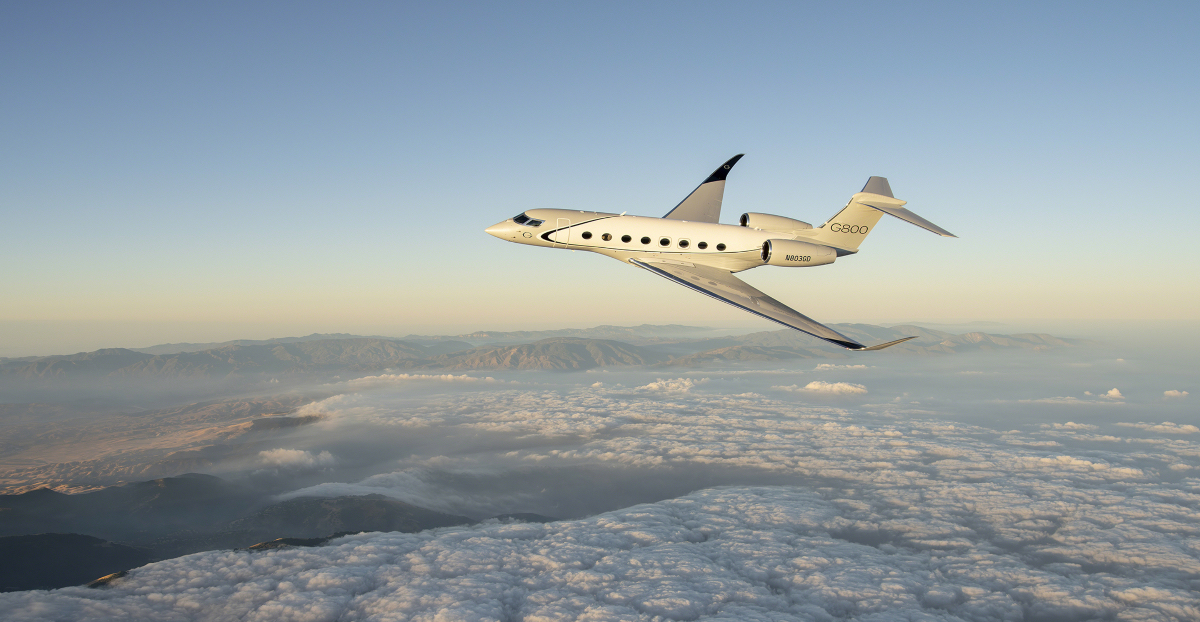
Gulfstream, meanwhile, has been busy rewriting its own record books. In June 2026, its G800 secured the manufacturer’s 800th city-pair speed record, flying from Reykjavik to Savannah; 2,973 nautical miles in five hours and 52 minutes at an average of Mach 0.91. Weeks later, on 28 June, the same aircraft completed what Gulfstream describes as the farthest, fastest flight in business aviation history: Melbourne to Moline, Illinois, covering 8,303 nautical miles in just under seventeen hours. The G800, which entered service in August 2025, has now notched up 15 records on its own, contributing to a fleet-wide total of 815. With a maximum range of 8,200 nautical miles and a top operating speed of Mach 0.935, it is built for ultra-long-haul missions, offering up to four separate living areas and 16 panoramic oval windows.
Asia-Pacific: The Industry’s Growth Engine
If speed records define the hardware race, Asia-Pacific defines the demand race. Vista, parent company of VistaJet and the on-demand marketplace XO, reported a 26 per cent year-on-year rise in Programme membership across the region in the first half of 2025, with Japan the standout market at 67 per cent growth, followed by Singapore at 50 per cent.
Hong Kong and Singapore remain the principal gateways for North and Southeast Asia respectively, while Kuala Lumpur and Tokyo continue to attract both corporate and leisure travellers.
Ian Moore, Chief Commercial Officer at Vista, attributed much of this momentum to the blurring line between business and leisure travel, “One of the key drivers behind the strong demand is that these cities cater to both business and leisure travel. They are not only major commercial hubs in Asia, but also highly popular tourist destinations. We are seeing a clear trend among entrepreneurs and senior executives toward ‘bleisure travel’, combining work commitments with vacation time. Particularly with high net-worth individuals, the line between business and private time is increasingly blurred, as they often travel with family members.”
XO, which now provides access to more than 2,000 aircraft globally, saw international bookings surge by nearly 40 per cent. Crystal Wong, President of Asia Pacific at Vista, pointed to demand for flexibility as the driving factor: “We are seeing increasing demand from clients in Asia who are seeking flexible and instant flight solutions. Through the XO mobile application, Asian clients may book and confirm their flights with real-time pricing. It is the simplest and most flexible way to begin flying privately.”
In an industry showcase on regional UHNW trends, Vista highlighted Singapore’s status as Southeast Asia’s central hub for private aviation and financial capital. Private jet arrivals in Singapore surged around major global events – notably seeing a staggering 362% spike in flight traffic during major concert stops (like the Taylor Swift Eras Tour), a 168% surge during the Singapore Grand Prix and Milken Institute!
Manufacturers Race to Build Out Infrastructure
Demand of this scale requires infrastructure to match, and Singapore has become the clearest beneficiary. In early June 2026, Bombardier announced a whopping US$100 million investment to expand its maintenance and service hub at Seletar Airport, nearly doubling its existing footprint and creating 200 skilled jobs at a new 250,000 sq ft facility. Construction is set to begin in the second half of 2026, with operations expected to start in 2028. The expansion follows a record order backlog exceeding US$20 billion reported by Bombardier in April, with up to 10 per cent of that backlog originating from the Asia-Pacific region.
Gulfstream responded within weeks, partnering with Jet Aviation to open its first dedicated customer support centre at the same Seletar site, staffed by a team of eight covering technical, materials, sales and field service functions.
The facility complements Gulfstream’s existing 5,000 sq ft parts distribution centre in Singapore, which fulfils more than 70 per cent of the region’s spare parts orders and holds over US$70 million in dedicated inventory. Separately, private aviation services provider WingsOverAsia broke ground earlier this year on a new maintenance and innovation facility at Seletar, designed to accommodate larger aircraft such as the Gulfstream G700 as well as Boeing and Airbus corporate jets, with operations targeted for 2027.
New Aircraft Enter Service
The infrastructure push has coincided with a flurry of new aircraft announcements. At Farnborough in June 2026, Gulfstream marked the European debut of its G300 and G400, both unveiled in September 2025. The super-midsize G300 offers the longest cabin in its class, seating up to ten passengers with a range of 3,600 nautical miles at Mach 0.80. The G400, positioned as the fastest and farthest-flying aircraft in its category, set its own city-pair speed record en route to the airshow, completing a 3,250 nautical mile flight from Washington, D.C. in six hours and 12 minutes using sustainable aviation fuel.
The same week brought Gulfstream’s 100th delivery of the flagship G700, an aircraft the manufacturer now regards as the benchmark of the business aviation industry. The milestone delivery also produced a new city-pair record, linking Savannah with San Jose in four hours and 36 minutes at Mach 0.91, before the aircraft continued on to Teterboro, New Jersey, in a further record-setting four hours and 14 minutes at the same cruise speed.
Taken together, these developments point to an industry in the midst of a genuine transformation: one where speed, comfort and reach are being redefined in real time, and where Asia’s wealthy are increasingly setting the pace of demand.